Can You Trust Your Own Decisions? Try This for 7 Days
 Chantal et David Genecand

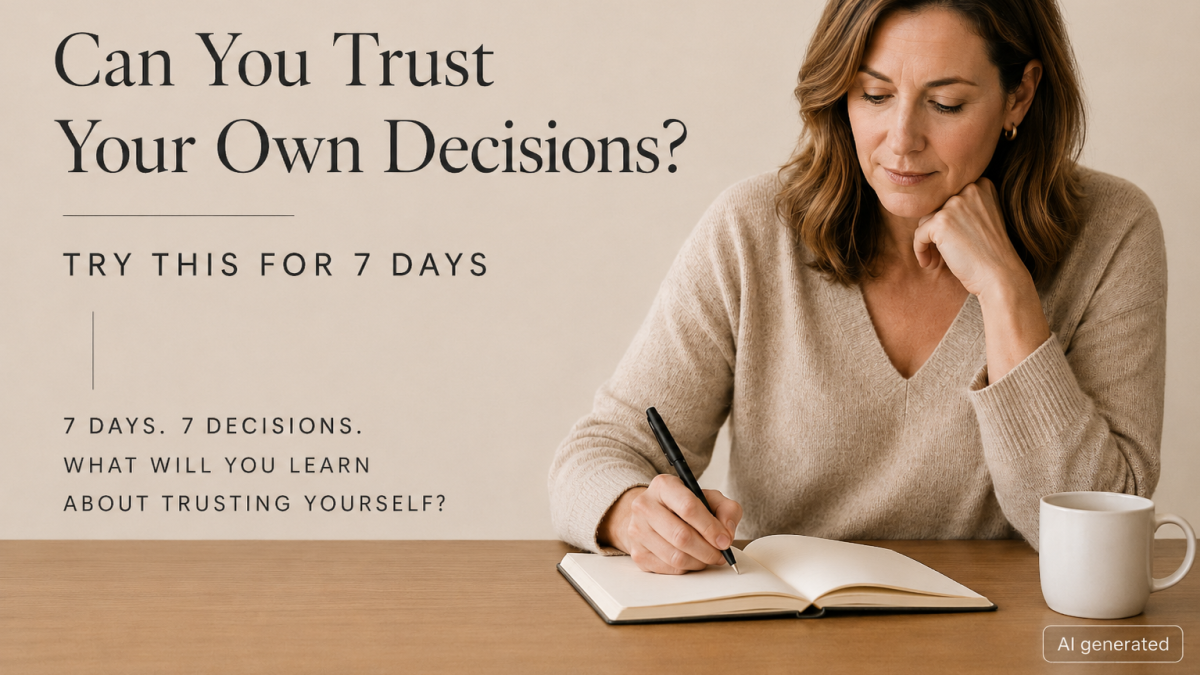
A simple 7-day experiment to notice when you trust yourself, when you override yourself, and what happens afterwards.
Can You Trust Your Own Decisions? Try This for 7 Days
Have you ever made a decision, felt quite clear about it, and then spent the next hour questioning yourself?
Perhaps you chose not to attend something because you were tired. Then you wondered if you were being antisocial. You decided you didn’t want to take on another commitment, then started thinking about all the reasons you probably should. Or you knew which option you preferred, but asked three other people what they thought until you were no longer sure what you thought.
It is easy to assume that self-trust means always being certain.
It doesn’t.
Self-trust is not about never changing your mind or always making the perfect decision. It is about becoming more aware of your own responses, recognising what influences them, and learning from what happens when you listen to yourself — or don’t.
And one of the easiest ways to begin is to stop trying to solve the whole problem at once.
Instead, collect some evidence.
Try this for seven days
For the next seven days, choose one small decision each day and write it down.
Not a major life decision. Not whether to leave your job, end a relationship or move to another country.
Choose ordinary moments.
Perhaps:
- whether you want to go out or stay home
- whether you want to answer a message immediately
- whether you actually have time for another commitment
- which option you prefer without asking someone else first
- whether your body needs a break or you want to continue working
- whether you want to accept an invitation
- whether something feels like a yes, a no, or simply not yet
The aim is not to judge the quality of the decision. You are simply becoming interested in how you make it.
For each decision, answer three questions.
1. What did I originally know or want?
Try to capture your response before the negotiation began in your head.
Maybe it was:
I really don’t want to go tonight.
I need an afternoon to myself.
I prefer option B.
I don’t have the capacity for this.
I actually want to say yes.
Sometimes your first response will be clear. Sometimes it won’t be. That is useful information too.
The important thing is not to manufacture certainty where there isn’t any.
Simply notice what was there first.
2. What did I actually choose?
Now look at what happened next.
Did you follow your original response?
Did you override it?
Did you change your mind because genuinely new information appeared?
Or did your answer begin shifting after you imagined someone else’s reaction, worried about making the wrong choice, or started asking other people what they would do?
There is no “correct” answer here.
You are collecting data about yourself, not giving yourself a score.
For example:
Original response: I wanted to stay home tonight.
What I chose: I went anyway.
What influenced me: I worried they would think I was letting them down.
Or:
Original response: I wasn’t sure whether I wanted to accept the project.
What I chose: I asked for 24 hours before answering.
What influenced me: I realised I genuinely needed more information.
Both examples tell you something useful.
3. How did I feel afterwards?
This is the part we often skip.
Once the decision has been made, notice what happened afterwards.
Did you feel relieved?
Calm?
Energised?
Resentful?
Drained?
Proud?
Uneasy?
Did you continue thinking about the decision for hours?
Did you wish you had answered differently?
Again, the goal is not to decide that one feeling is “good” and another is “bad”.
Sometimes the right decision can still feel uncomfortable. Sometimes an easy decision creates short-term relief but leaves resentment afterwards.
You are simply paying attention to the pattern.
What you may begin to notice
After a few days, certain themes may start appearing.
Perhaps your first instinct is often clearer than you realised.
Perhaps you regularly know what you want, but begin doubting it once somebody else has an opinion.
Maybe you say yes quickly and only recognise your real answer later, when you feel exhausted or resentful.
Or perhaps you discover something different: you tend to react quickly, and giving yourself more time actually helps you make better decisions.
There is no result you are supposed to find.
The point of the exercise is to become more familiar with your own process.
Because it is difficult to trust something you rarely stop long enough to hear.
Self-trust does not mean always following your first instinct
This distinction matters.
Your first reaction is not automatically the truth.
Sometimes we react from habit, fear, tiredness or incomplete information. New information may absolutely change your mind, and being willing to reconsider is a strength.
Self-trust is not stubbornness.
It is being able to recognise why your answer changed.
Did something genuinely shift?
Or did you simply become uncomfortable with your original choice?
Imagine you decide not to attend an event because you are exhausted. Later, you discover that someone important to you is only in town for that evening. You reconsider and decide to go.
That is new information.
But if nothing changes except that someone says, “Oh, I was really hoping you would come,” and you immediately abandon your decision, that is a different kind of influence.
Neither needs to be judged.
But they are worth learning to distinguish.
Pay attention to the decisions you keep outsourcing
You may also notice how often you ask other people to help you decide.
There is nothing wrong with seeking advice. Other people can see things we cannot, and expertise matters.
But there is a difference between gathering useful information and asking someone else to tell you what you should want.
You might recognise yourself saying:
What would you do?
Do you think I’m being unreasonable?
Are you sure this is okay?
Would you be upset if I said no?
Sometimes underneath the request for advice is another question:
Can you reassure me that I am allowed to make this choice?
That is an interesting thing to notice.
Before asking someone else what they think, try asking yourself first:
What do I think?
You can still seek advice afterwards. But you have recorded your own voice before everyone else enters the conversation.
At the end of seven days, look back
At the end of the week, read through your seven decisions.
Don’t look for perfection. Look for patterns.
Ask yourself:
When did I feel clearest?
When did I begin doubting myself?
Whose reactions influence me most?
When I overrode my original response, how did I feel afterwards?
When I trusted myself, what happened?
Do I tend to decide too quickly — or spend too long trying to be certain?
And perhaps the most useful question:
What have these seven days taught me about the way I make decisions?
You may discover that you trust yourself more than you thought.
Or you may notice just how quickly your own preference disappears once other people’s opinions enter the room.
Either way, you have something you did not have seven days ago:
evidence.
You do not need to become more certain
Many people wait to trust themselves until they feel completely confident.
But complete confidence may never arrive.
There will always be decisions where you cannot know the outcome in advance. There will always be moments of doubt, incomplete information and competing needs.
Self-trust is not certainty about the future.
It is knowing that you can listen to yourself, make the best decision you can with what you know today, and respond to what happens next.
You are allowed to reconsider.
You are allowed to make mistakes.
You are allowed to learn.
And you are also allowed to discover that sometimes you already knew what you wanted before you started trying to convince yourself otherwise.
Your 7-day self-trust experiment
For the next seven days, write down just three things:
1. What did I originally know or want?
2. What did I actually choose — and what influenced me?
3. How did I feel afterwards?
That is all.
Seven decisions. Seven small opportunities to become more familiar with yourself.
At the end of the week, don’t ask:
Did I make all the right decisions?
Ask:
What did I learn about trusting myself?
That is a much more interesting place to begin.
Categories: : blog
