I Looked Strong. Then My Hand Started Shaking.
 David Genecand

A personal story about anxiety, hiding vulnerability, and what happened when my body revealed what I was trying to conceal.
I Looked Strong. Then My Hand Started Shaking.
I was sitting in the cafeteria with members of my team when I picked up my spoon to eat my soup.
My hand started shaking.
Not slightly. I could not control it.
And in that moment, I wasn’t wondering what had caused it or what my body might be trying to tell me. I had only one thought:
Please don’t let anyone notice.
At the time, I was managing two departments and climbing the corporate ladder. I wanted to prove myself and be seen as capable, reliable and strong.
From the outside, there was little reason for anyone to think otherwise. I had responsibility, I was successful in my career, and I knew how to solve problems, lead people and keep moving when things became difficult.
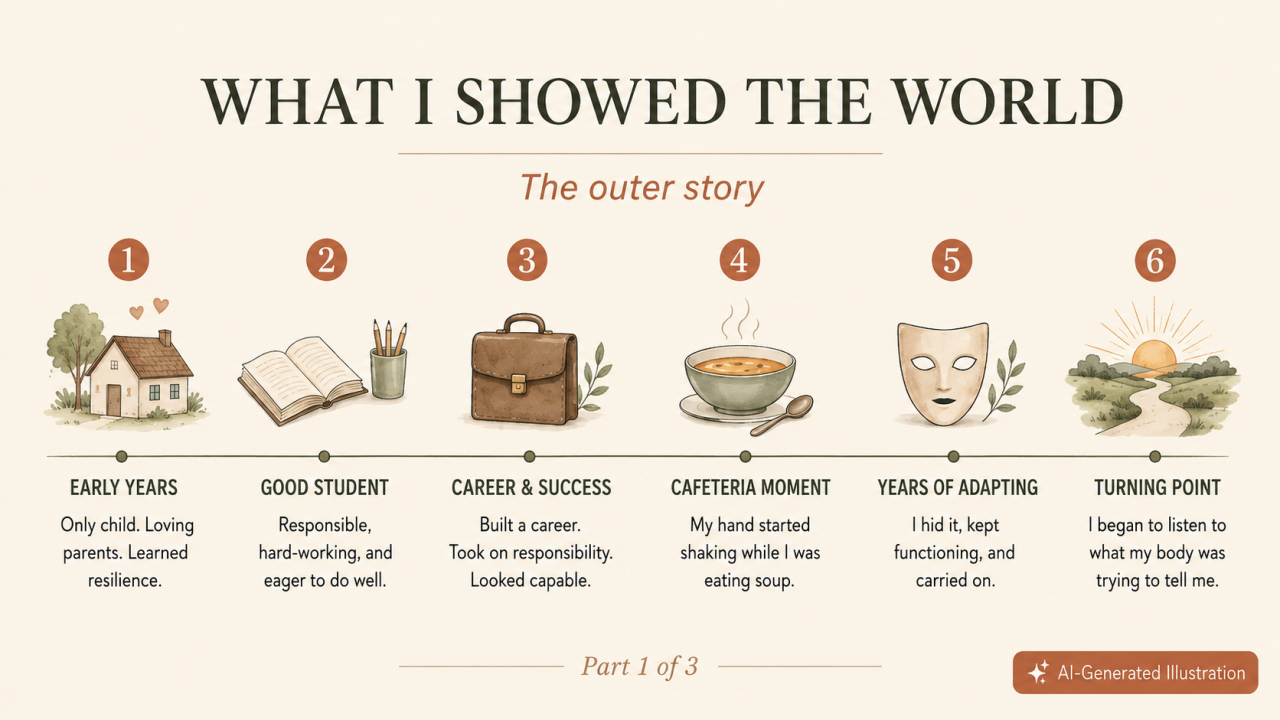
But sitting there with that spoon in my hand, the image I had worked so hard to maintain suddenly felt very fragile.
Because underneath the capable exterior, there was another side of me that very few people saw.
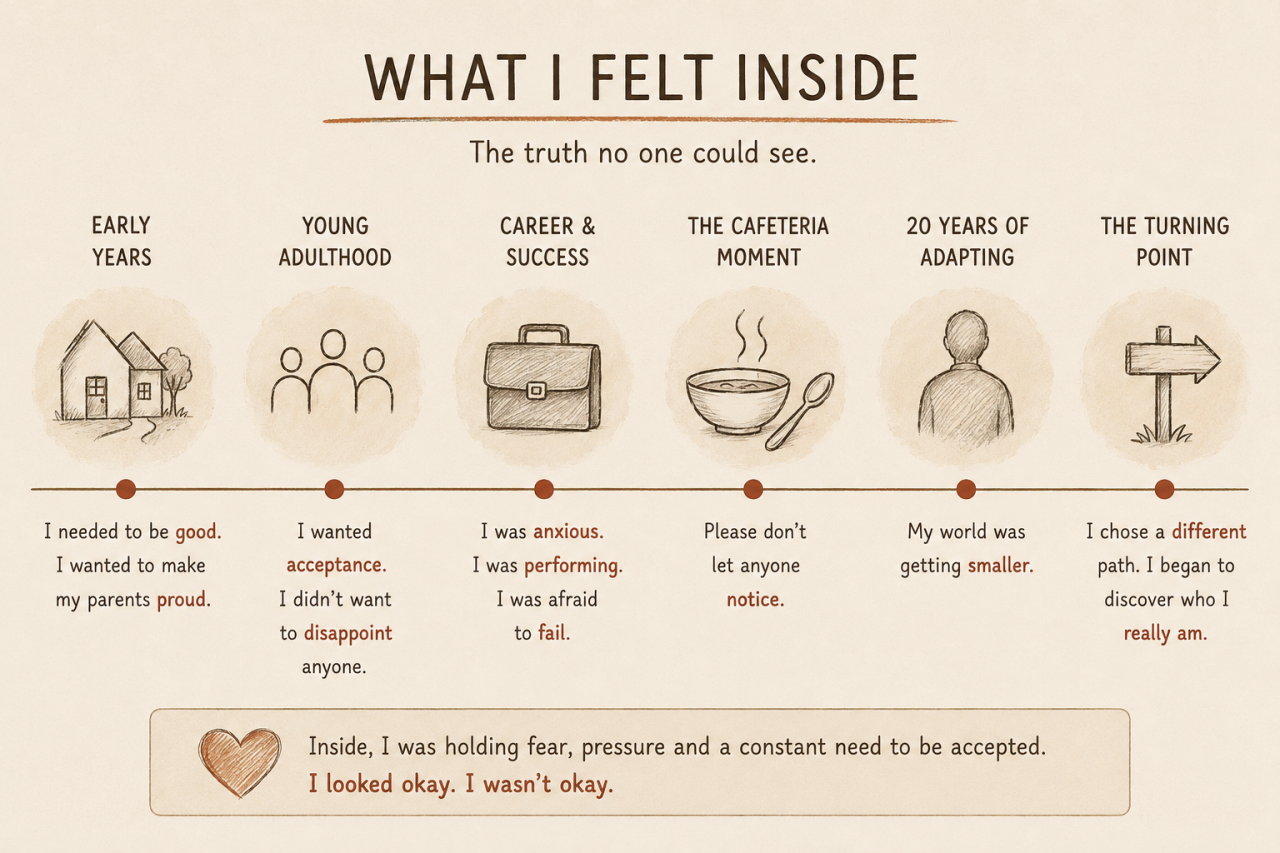
I worried about what people thought of me. I hated disappointing people. Confrontation made me deeply uncomfortable, and failure frightened me far more than I wanted to admit.
I had become extremely good at making sure none of that was visible.
So when my hand started shaking, the shaking itself frightened me. But what frightened me even more was the possibility that somebody might see it.
What happened after that lunch
I wish I could say I went home that evening, understood exactly what was happening and began changing my life.
I didn’t.
I did what I knew how to do: I adapted, pushed through and tried to control it.
Lunches became stressful. Sometimes I would choose a sandwich or something I could eat with my hands so I wouldn’t have to worry about holding a fork or spoon.
I became conscious of who was sitting around me. Would they notice? Would it happen again? Could I hide it if it did?
A simple meal could suddenly feel like something I needed to prepare for.
And this pattern did not disappear after a few weeks. It followed me, in different forms, for almost twenty years.
From the outside, I continued functioning. I worked, took responsibility, became a father and continued building my career.
Life moved forward.
But inside, my world was quietly becoming smaller.
The fear was not only about shaking
Looking back now, I can see that the physical reaction was only part of what frightened me.
What I was really afraid of was being exposed.
I had built an identity around being capable: the man who could handle things, the person others could rely on, the one who kept going.
Suddenly, my body was doing something I could not simply command it to stop doing.
What if someone saw me differently? What if they thought I was weak? What if I lost control? What if the version of me I wanted people to see was not the whole story?
At the time, I didn’t have those words.
I simply knew that I did not want anyone to notice.
Maybe your body has never shaken in a cafeteria
Your experience may look completely different.
Perhaps you carry tension in your shoulders without noticing anymore. Maybe your mind starts replaying conversations the moment you lie down at night. Maybe your stomach tightens before seeing a particular person, or you become unusually quiet when conflict appears.
Or perhaps you keep telling everyone you are fine because, technically, you are.
You are still working. Still helping. Still getting things done.
Still functioning.
And because you are functioning, it can be easy to assume everything must be okay.
Of course, not every physical symptom is emotional, and physical symptoms deserve appropriate medical attention. But in my own life, there eventually came a point when I had to become curious about something beyond the symptom.
Instead of asking only:
How can I stop this from happening?
I began asking:
Why does the possibility of someone seeing me struggle feel so threatening?
That question opened a very different door.
I became very good at appearing okay
Long before that cafeteria moment, I had learned the value of being responsible.
I grew up with two loving parents who both worked hard. My father was a strong and positive character who taught me resilience, perseverance and the importance of continuing when things became difficult.
Those qualities became part of me, and I am grateful for them.
But over time, I can also see how easily resilience can become something else when you begin to believe that you must always cope.
You stop saying when something hurts. You avoid asking for help. You keep going because stopping feels uncomfortable. You become careful about showing vulnerability.
Slowly, without making a conscious decision, you can begin organising your life around how other people see you.
Looking back, I can see how much of my life revolved around being accepted, avoiding disappointment and appearing capable.
I had learned to be the good student, the responsible one, the strong one, the person who did not create problems.
There was nothing false about everything I had achieved.
But it wasn’t the whole picture either.
When strength becomes something you have to perform
There is nothing wrong with being strong. I still value strength enormously.
I value resilience, responsibility, commitment and showing up when life is difficult.
But today, I see an important difference between having strength and having to appear strong all the time.
When strength becomes something you must perform, there is very little room for saying:
I’m struggling.
I don’t know.
I’m frightened.
I need some help.
Or simply:
This doesn’t feel right for me.
For me, being strong had gradually become connected with hiding the parts of myself that I thought might disappoint people.
And hiding yourself takes a lot of energy.
The mask can work surprisingly well
This is perhaps one of the strangest things I have learned.
You can live behind a mask and still be successful.
You can build a career, lead people, raise a family, laugh, travel and achieve things you are genuinely proud of. Other people may even admire how composed you seem.
The mask does not necessarily stop your life from working.
Sometimes it helps you function extremely well.
But somewhere inside, you know how much effort it takes to maintain.
I wasn’t deliberately deceiving anyone.
I was protecting something.
I just didn’t understand that at the time.
I thought my body was betraying me
For a long time, I treated the shaking like an enemy.
I wanted it gone. I wanted to control it. I wanted my body to behave normally so I could get on with my life.
It took me a long time to see things differently.
Eventually, one thought began to change the way I related to what was happening:
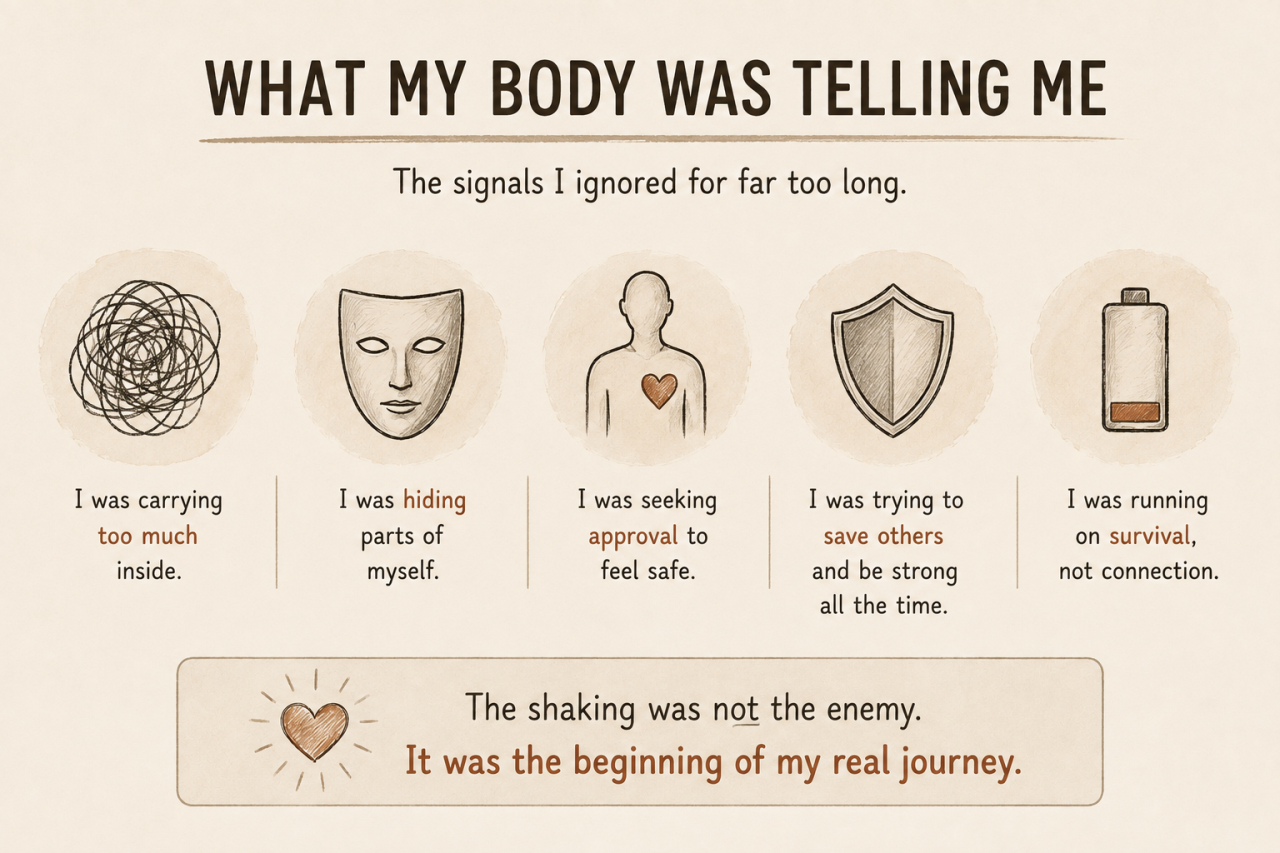
My body was not betraying me. It was speaking.
Not because I believe every symptom contains some hidden emotional message. But because, in my case, my physical reaction forced me to notice something I had become very skilled at ignoring.
I was anxious. I was afraid of being judged. I was hiding vulnerability. I was trying desperately to remain in control.
And I was carrying far more internally than the people around me could see.
The shaking made that difficult to ignore forever.
It took me a long time to listen
There was no dramatic overnight transformation.
I searched. I read books. I tried different approaches. For a long time, I continued adapting my life around the fear.
Understanding myself happened gradually.
Perhaps one of the biggest changes was simply becoming less interested in fighting myself and more interested in understanding myself.
What was I protecting?
Why was approval so important to me?
Why did vulnerability feel so uncomfortable?
Why did disappointing someone feel almost like failing?
And who was I when I wasn’t trying to be the man everyone expected me to be?
Those questions eventually became far more important than the shaking itself.
Today, strength means something different
I still don’t have everything figured out, and I no longer feel that I need to pretend that I do.
I am still learning, still growing and still discovering parts of myself.
But the shaking no longer controls my life.
More importantly, neither does the same need to maintain an image of myself at all costs.
Today, strength feels less like proving that nothing affects me and more like being able to tell myself the truth.
To acknowledge when something is difficult.
To admit when I am frightened.
To allow myself to be seen without needing to control every impression.
I spent many years trying to make sure nobody saw my hand shake.
Eventually, I realised the deeper journey was not about becoming better at hiding it.
It was about becoming someone who no longer needed to hide himself.
A reflection for you
Perhaps your body has never shaken while eating soup.
But think about the moments when something in you seems to react more strongly than you would like.
Where do you tense? Where do you shut down? Where do you begin overthinking? Where do you automatically say, “I’m fine” when you’re not?
And perhaps there is one more question worth sitting with:
What are you working so hard to prevent other people from seeing?
You don’t need to find the answer immediately.
Sometimes curiosity is enough to begin.
Categories: : blog
