The Kids Have Left. Why Am I Still Cooking for Five?
 Chantal Genecand

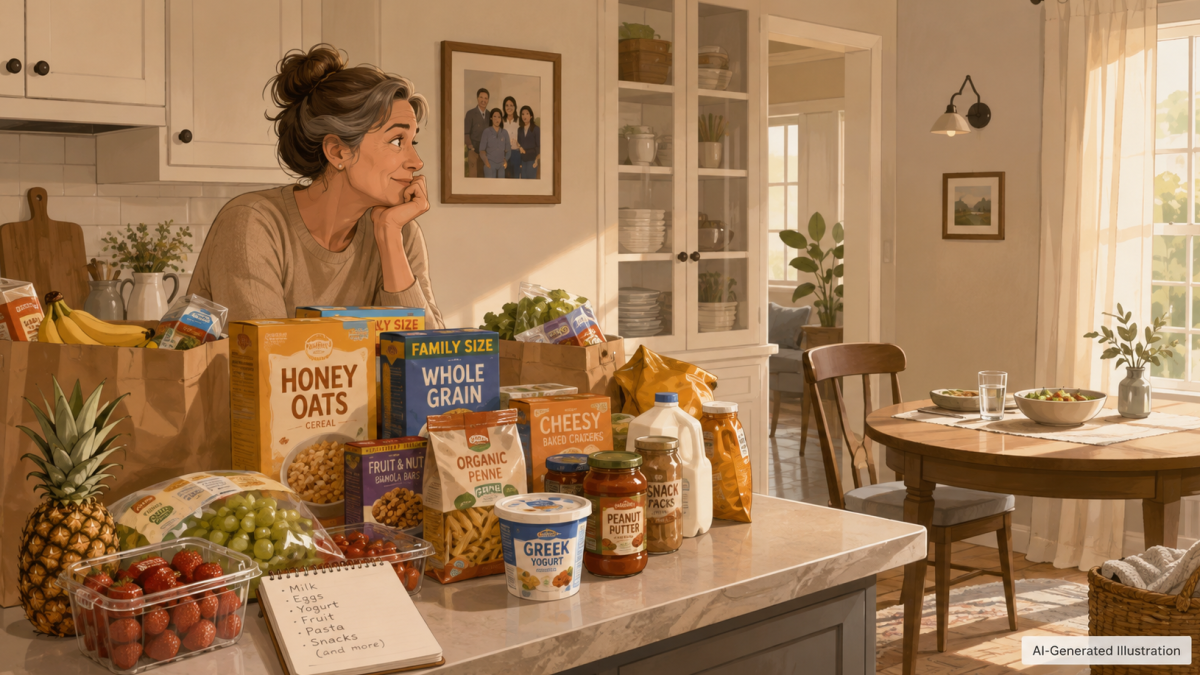
The children have left, but old routines remain. A lighter look at empty-nest habits and what the new space might be asking of you.
The Kids Have Left. Why Am I Still Cooking for Five?
I realised something slightly ridiculous the other day.
You can know perfectly well that your children no longer live at home and still shop as though they might arrive with three hungry friends at any moment.
The trolley fills itself almost automatically. The familiar cereal goes in. Too much pasta. The snacks you have bought for years. Enough food to cover the kind of week that simply doesn’t happen anymore.
Then you get home, open the fridge and remember:
There aren’t that many people living here now.
Maybe groceries aren’t your thing. But if your children have recently left home — or they simply don’t need you in the same daily way anymore — you may recognise the strange lag between what life looks like now and the routines your brain is still running.
Your children leave. Your autopilot takes a little longer.
For years, your days may have had a structure you barely needed to think about.
Meals happened at certain times. Somebody needed a lift. There was always something to remember, organise, wash, buy, fix or listen to. Weekends had a rhythm. Holidays had logistics. Your phone was partly a communication device and partly family headquarters.
Then the role changes.
Not necessarily overnight. Often gradually.
One child moves away. Another is at university. Perhaps they still come home, but they increasingly have lives that no longer revolve around yours.
Which is exactly what you raised them to do.
You can be enormously proud of that.
And still find yourself standing in a supermarket holding a family-sized box of cereal thinking:
Who exactly am I buying this for?
Some habits are practical. Others are emotional.
The obvious routines are easy to spot.
Cooking too much food. Doing laundry that is no longer there. Automatically checking whether someone will be home for dinner.
But some habits are subtler.
Maybe you still check your phone more often than you need to because, for years, a message could mean someone needed something.
Perhaps you hear yourself asking, “What is everyone doing this weekend?” before remembering that everyone now has their own weekend.
Maybe you walk past a bedroom and think about changing the sheets, tidying something or putting something away.
Or perhaps you suddenly realise that nobody actually needs to know where you are going this afternoon.
That one can feel strangely rebellious.
“You must love having all this freedom!”
People mean well when they say this.
And perhaps sometimes you do love it.
You can eat when you want. Travel more easily. Stay out. Stay in. Make dinner or decide that cheese and crackers counts perfectly well.
There may be genuine relief in no longer being responsible for so many moving parts.
But freedom can feel surprisingly odd when your life has been structured around other people for twenty or thirty years.
You imagined more time.
Then the time arrived.
And nobody explained what you were supposed to do with it.
That does not mean something is wrong.
It may simply mean that the old structure disappeared before the new one had time to form.
The funny things can carry a little sadness too
You can laugh at the oversized grocery shop and still miss the chaos.
You can enjoy not doing the school run and still remember those ordinary journeys with affection.
You can be relieved that nobody is asking what is for dinner and occasionally wish somebody would.
You can adore seeing your children independent and still feel a pang when they no longer need your advice.
More than one feeling can exist at the same time.
Pride and sadness.
Freedom and loss.
Relief and loneliness.
Excitement and absolutely no idea what comes next.
You don’t need to choose one and declare it the “correct” empty-nest emotion.
Maybe the question isn’t “What should I do now?”
When life suddenly creates space, there can be a temptation to fill it quickly.
Take the course.
Book the trip.
Start the project.
Redecorate the house.
Join something.
Find a new passion.
And there is nothing wrong with any of those things.
But you don’t necessarily need to replace the old life immediately.
Sometimes it is more interesting to notice what is happening before rushing to solve it.
So here is a small experiment for the coming week.
The Empty-Nest Autopilot Check
For seven days, notice three things.
1. What am I still doing automatically?
Something small is enough.
Maybe you cook too much.
Keep evenings free out of habit.
Buy something nobody eats anymore.
Wait for everyone else’s plans before making your own.
Notice it without criticising yourself.
It may simply be evidence of how deeply a role became woven into your everyday life.
2. Where has space appeared?
Not where you should be doing something productive.
Where is there simply more room than there used to be?
An evening.
A Saturday morning.
An empty corner of the house.
An hour after work.
A holiday that no longer needs organising around five different schedules.
For now, you do not need to fill it.
Just notice that it exists.
3. What am I curious about?
This is the fun one.
Not:
What is my purpose now?
That is far too much pressure for a Wednesday afternoon.
Ask instead:
What am I curious about?
Maybe there is somewhere you would like to visit.
Something you used to enjoy.
A restaurant nobody else in the family ever wanted to try.
A class you have secretly fancied.
A friend you would like to see more often.
A room you would like to use differently.
Something completely impractical.
Curiosity is much lighter than trying to reinvent your life.
Follow one small thread and see where it goes.
Your home may need to catch up too
Homes have memories built into them.
The kitchen table has a history.
So does the hallway.
The fridge door.
The spare bedroom that isn’t quite a spare bedroom yet.
You do not need to immediately transform your child’s room into a yoga studio, office, walk-in wardrobe or Scandinavian reading sanctuary.
Unless you really want to.
But it can be interesting to ask:
Does my home still reflect the life we had — or is it beginning to make room for the life I have now?
That question does not require a dramatic renovation.
Maybe you simply move something.
Use a room differently.
Claim one drawer.
Put the chair where you want it.
Small changes can quietly signal that you still live here too.
And what about you?
This may be the deeper transition underneath all the funny little habits.
For years, so many questions naturally involved other people.
What do the children need?
Where do they have to be?
What are we eating?
What is happening this weekend?
Who needs help?
Then those questions become less urgent.
And underneath them, another question can slowly appear:
What do I want?
That question may feel surprisingly difficult.
Not because you have no desires.
Perhaps you simply haven’t needed to consult them very often.
There is no rush to produce a brilliant answer.
Start small.
What do you want for dinner?
How do you want to spend Saturday morning?
Who do you actually feel like seeing?
What would make this week slightly more enjoyable?
A life that feels like yours again may begin with much smaller questions than you expect.
So, about that family-sized grocery shop…
You probably don’t need to stop buying your children’s favourite food completely.
They may come home next weekend and empty the fridge in twelve minutes anyway.
Some things never change.
But perhaps the next time you are walking through the supermarket, add one more question:
What do I want?
Not the family.
Not the children.
Not everyone coming home at Christmas.
You.
Maybe it is a food nobody else liked.
Maybe it is something extravagant.
Maybe it is simply one less carton of milk.
Whatever it is, put it in the trolley.
Consider it a very small declaration that while the family has changed, your life has not finished expanding.
A small reflection for this week
Notice:
One thing I still do automatically because I was needed differently before.
One piece of space that has appeared in my life.
One thing I am curious about now.
Nothing needs to be fixed.
Nothing needs to be reinvented.
You are simply beginning to notice that the shape of life has changed.
And perhaps, very gradually, you get to have some fun deciding what goes into the new spaces.
Categories: : blog
