Is It Really Yours to Carry? How to Stop Taking Responsibility for Everyone Else
 Chantal et David Genecand
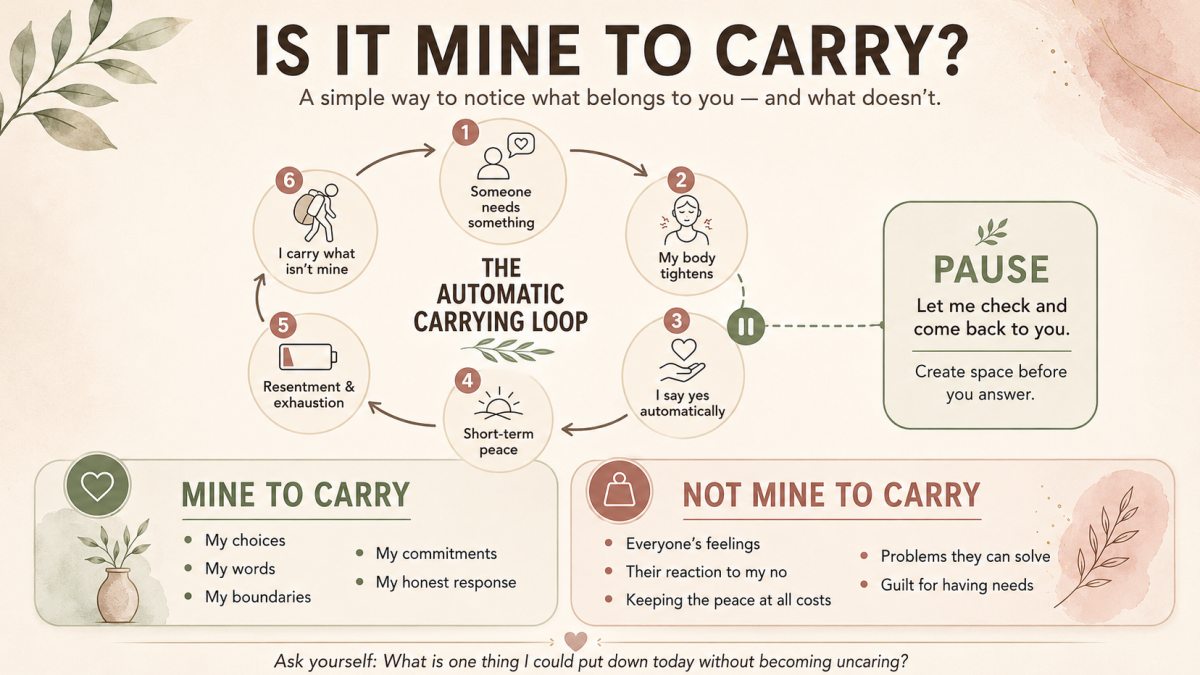
Do you feel responsible for everyone’s emotions and problems? Learn how to recognise emotional over-responsibility, interrupt the automatic carrying l
Is It Really Yours to Carry? How to Stop Taking Responsibility for Everyone Else
Some of the heaviest things we carry are invisible.
The worry about how someone else is feeling.
The responsibility for keeping the peace.
The pressure to make sure everyone is okay.
The need to solve a problem before anyone has even asked us to.
The guilt that appears when someone is disappointed by a choice we make.
None of this is visible from the outside.
You may simply look capable, dependable and calm.
But underneath, you may be carrying other people’s emotions, needs, reactions and problems as though they were your personal responsibility.
And after years of being the strong one, the helper or the person everyone depends on, it can become difficult to recognise where your responsibility ends and someone else’s begins.
The invisible weight of being the one who holds everything together
Perhaps you notice that someone is upset and immediately wonder what you need to do.
Perhaps someone has a problem and you start finding solutions before they have even asked for your help.
Perhaps a family member is disappointed by a decision you have made, and you feel responsible for making them feel better.
Perhaps there is tension in the room, and you instinctively begin adjusting yourself to restore the peace.
You soften your words.
You change your plans.
You explain yourself one more time.
You take on a little more.
You tell yourself:
It is easier if I just deal with it.
They are already struggling.
I do not want to make things worse.
I can handle it.
And perhaps you can handle it.
You probably have handled a great deal for a very long time.
But being capable of carrying something does not automatically mean it belongs to you.
Caring is not the same as carrying
There is an important difference between caring about someone and carrying their entire emotional experience for them.
Caring may sound like:
I can see that you are upset.
I am here if you want to talk.
I care about what you are going through.
Carrying may sound like:
I must make sure you are no longer upset.
I need to change my decision so you feel better.
Your discomfort means I have done something wrong.
Caring allows another person to have their own feelings.
Carrying makes their feelings your responsibility.
Caring offers support.
Carrying takes over.
Caring respects the other person’s ability to face their own experience.
Carrying often assumes that you must rescue, fix, manage or absorb it for them.
You can be compassionate without abandoning yourself.
You can love someone without taking responsibility for everything they feel.
You can support another person without carrying what belongs to them.
The automatic carrying loop
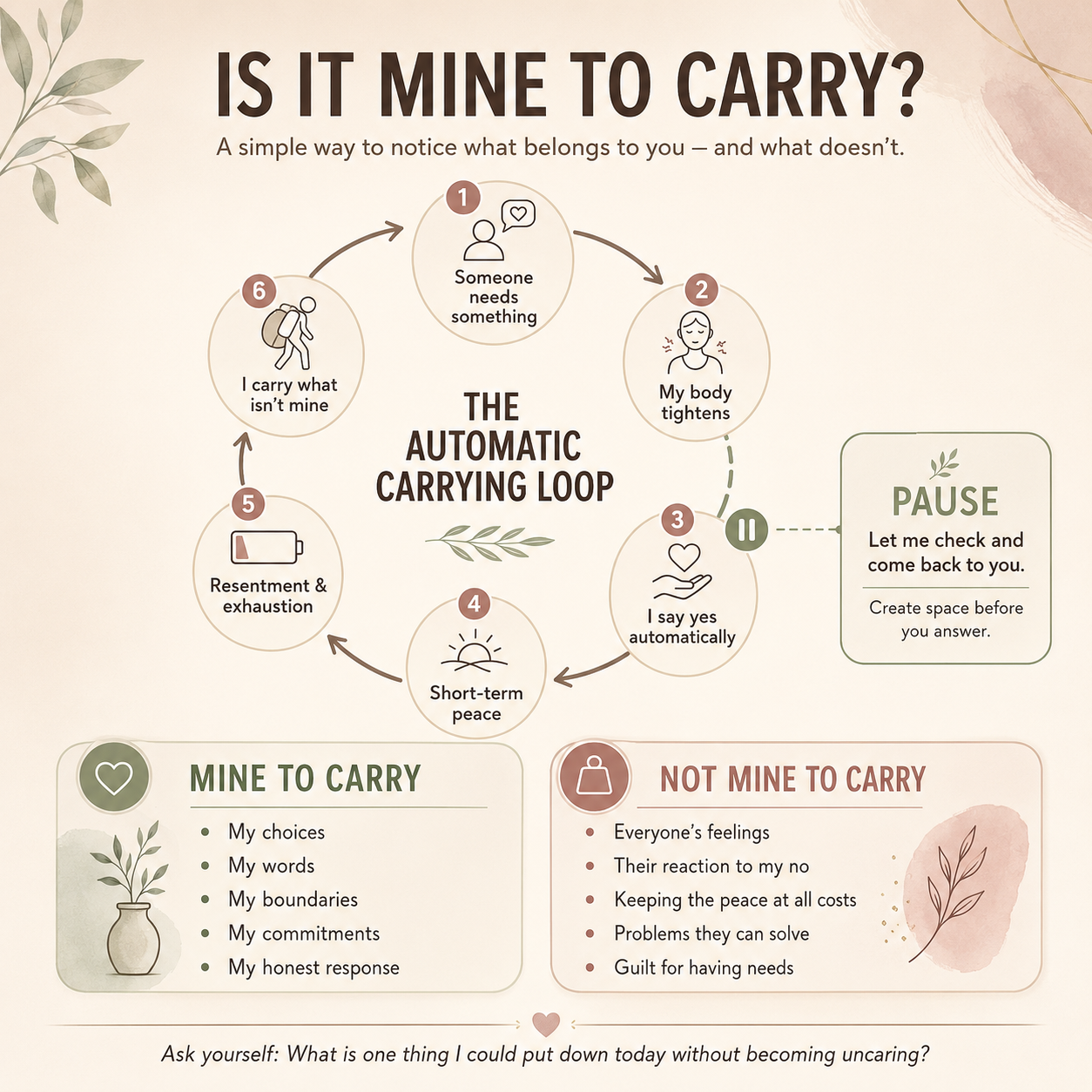
This pattern often happens very quickly.
So quickly that you may not notice it until you are already exhausted or resentful.
The loop can look something like this:
1. Someone needs something
They ask for help.
They are upset.
They have a problem.
They want more of your time, attention or energy.
Sometimes they may not even ask directly. You simply sense that something is wrong and begin moving towards it.
2. Your body tightens
Your shoulders rise.
Your breath becomes shallower.
Your jaw clenches.
Your stomach contracts.
You may feel a familiar urgency:
I need to deal with this.
3. You say yes or step in automatically
You offer help before checking whether you have the capacity.
You change your plans.
You take responsibility for solving the problem.
You reassure, explain or make yourself available.
You may not even realise you have made a choice.
It feels automatic.
4. There is short-term peace
The other person may feel relieved.
The tension may decrease.
Conflict may be avoided.
For a moment, everything feels settled.
This is why the pattern can be so difficult to change.
It appears to work.
5. Resentment and exhaustion grow
Later, you may feel tired, irritated or emotionally drained.
You may begin thinking:
Why am I always the one who has to deal with this?
Why does nobody ask what I need?
Why do people expect so much from me?
The resentment is not necessarily a sign that you do not care.
It may be the feeling that appears when you have ignored your own limit.
6. You carry what was never yours
You are now holding the task, the emotion, the decision or the responsibility.
The other person may have moved on.
But you are still thinking about it, managing it or worrying about the outcome.
Then the next request appears, and the loop begins again.
Why this pattern can feel so difficult to interrupt
For many women, over-responsibility is not simply a habit.
It may be connected to belonging, safety or identity.
Perhaps you learned that being helpful made you valuable.
Perhaps keeping the peace helped you avoid conflict.
Perhaps you became the reliable one because other people around you were overwhelmed, unpredictable or emotionally unavailable.
Perhaps you were praised for being mature, capable or easy to manage.
Over time, being needed may have become closely connected with feeling loved.
Saying yes may feel safer than risking disappointment.
Stepping in may feel easier than watching someone struggle.
Holding everything together may have become part of how you understand yourself.
This is why putting something down can feel uncomfortable, even when you know it is exhausting you.
You may worry that you are becoming selfish.
Cold.
Unreliable.
Uncaring.
But stepping out of over-responsibility does not mean becoming indifferent.
It means learning to care without disappearing inside someone else’s needs.
What is genuinely yours to carry?
You are responsible for your own choices.
Your own words.
Your own behaviour.
Your commitments.
Your boundaries.
Your honest response.
You are responsible for communicating respectfully.
You are responsible for acknowledging when you have caused harm.
You are responsible for deciding what you are available for.
You are responsible for keeping the promises you have freely made.
You are responsible for recognising when something no longer feels manageable and speaking about it honestly.
This is enough.
Responsibility does not require you to control every outcome.
What is not yours to carry?
You are not responsible for making sure nobody is ever disappointed.
You are not responsible for controlling another person’s reaction to your boundary.
You are not responsible for solving every problem someone brings to you.
You are not responsible for preventing all uncomfortable conversations.
You are not responsible for making decisions that keep everyone happy.
You are not responsible for another adult’s mood, choices or consequences.
You are not responsible for carrying guilt simply because you have needs of your own.
Someone can feel disappointed, and your decision can still be right for you.
Someone can disagree with you, and your boundary can still be valid.
Someone can struggle, and you can still allow them the dignity of finding their own way through it.
Resentment may be showing you where you abandoned yourself
Resentment is often treated as something negative or shameful.
But it can also carry useful information.
It may be showing you that you gave more than you genuinely wanted to give.
That you said yes when you wanted to say no.
That you took responsibility for something that was not yours.
That you stayed silent because speaking honestly felt too uncomfortable.
Instead of criticising yourself for feeling resentful, you might ask:
At what point did I know what I needed and override it?
That question is not about blaming yourself.
It helps you locate the moment where a different response may become possible next time.
The pause that can interrupt the loop
You do not always need to decide immediately.
One of the simplest ways to interrupt the automatic carrying loop is to create space before you answer.
You might say:
Let me check and come back to you.
I need a little time to think about that.
Let me look at what I already have on my plate.
I am not sure yet. I will come back to you later.
These phrases are not a rejection.
They are not rude.
They simply give you time to notice what is true for you before guilt, habit or urgency makes the decision.
During that pause, ask yourself:
Do I genuinely want to help?
Do I have the capacity for this?
Am I offering support, or am I taking over?
What part of this situation actually belongs to me?
What am I afraid might happen if I do not step in?
Your answer may still be yes.
But it will be a conscious yes, rather than an automatic one.
A simple exercise: Mine to carry / Not mine to carry
Take a piece of paper and divide it into two columns.
At the top of the first column, write:
Mine to carry
At the top of the second, write:
Not mine to carry
Now think of one situation that has been taking up a lot of emotional energy.
In the first column, write what genuinely belongs to you.
This might include:
- Speaking honestly
- Communicating respectfully
- Keeping a commitment
- Taking responsibility for your choices
- Deciding what you are available for
- Apologising if you have caused harm
Then write what does not belong to you.
This might include:
- Making sure nobody feels disappointed
- Controlling how someone reacts
- Solving a problem they can solve themselves
- Preventing every moment of tension
- Explaining yourself until everyone agrees
- Carrying guilt because your needs are different from theirs
Now look at the second column and ask:
What is one thing I could put down today without becoming uncaring?
Do not try to put down everything at once.
Choose one small weight.
Perhaps you stop checking repeatedly whether someone is still upset.
Perhaps you allow another person to find their own solution.
Perhaps you decide not to explain yourself again.
Perhaps you leave a message unanswered until you have the energy to respond.
Perhaps you let someone experience disappointment without immediately trying to remove it.
Putting something down does not mean you do not care
This is often the fear beneath the whole pattern.
If I stop carrying this, does it mean I do not care?
No.
Putting something down may simply mean you are learning to distinguish love from responsibility.
It may mean you trust the other person to carry their own part.
It may mean you are no longer measuring your worth by how much you can endure.
It may mean you are finally recognising that your energy, needs and limits belong in the relationship too.
You are allowed to care without carrying everything.
You are allowed to support without rescuing.
You are allowed to be loving without making yourself responsible for everyone else’s emotional world.
Self-trust grows when you stop taking over
Every time you pause before stepping in, you give yourself a different message.
I do not have to solve everything.
I can care without abandoning myself.
Other people are capable of carrying their own responsibilities.
My limits matter too.
These may seem like small moments.
But they begin changing the way you relate to yourself and to the people around you.
You stop automatically taking over.
You create space for others to take responsibility.
And you begin to feel the difference between being loving and being overburdened.
Sometimes putting something down is not abandonment.
Sometimes it is an act of trust.
Trust in the other person.
Trust in your boundary.
And trust that you do not have to carry everything to remain loving, valuable or connected.
Reflection
Think of one situation you are carrying today.
Ask yourself:
What part of this genuinely belongs to me?
What part belongs to someone else?
What am I afraid might happen if I put their part down?
Then choose one small action that allows you to remain caring without taking over.
Categories: : blog
